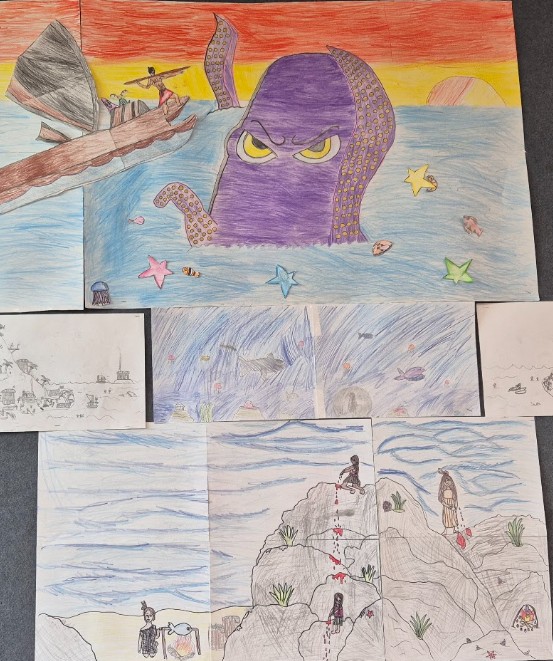
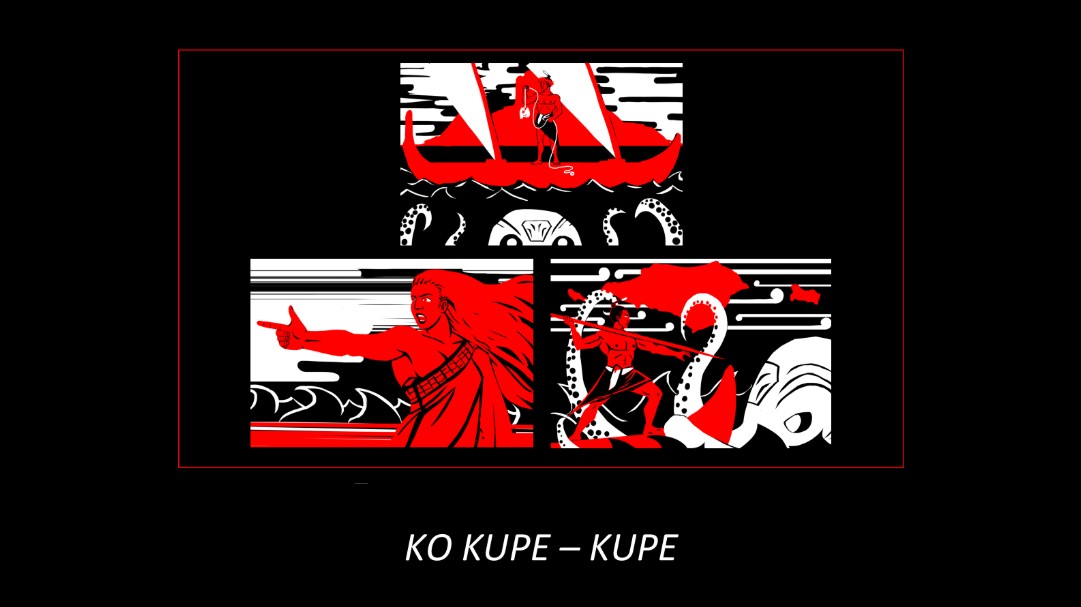
Far across the Pacific Ocean, in the beautiful island home of Hawaiki, a great tupuna and navigator named Kupe lived with his whānau. The moana surrounding Hawaiki was normally bursting with life, full of plump, shining fish. But one day, Kupe’s family came back from their fishing trip dismayed. When they pulled up their nets and lines, they didn’t find a delicious feast—only fish bones and half-eaten scraps!
Kupe went to investigate the mysterious fish thief. Peering deep into the clear blue water, he discovered the culprit: a gigantic, sneaky wheke with massive, writhing tentacles. And this wasn’t just any sea creature. It was the beloved pet of Kupe’s enemy, a man named Muturangi.
Kupe marched straight to Muturangi. “Your monster wheke is gobbling up all our food!” Kupe warned. “Tell it to stop, or I will have to hunt it down!” Muturangi just shrugged. “I can’t control what my pet does,” he replied with a smirk.
When the greedy wheke kept stealing every last fish, Kupe had had enough. He gathered his courage, loaded up his magnificent ocean-going waka, and set sail with his family, including his clever wife, Kuramarotini. Together, they launched into the vast blue Pacific Ocean on the trail of the giant wheke.
Day after day, the waka sliced through the waves. The moana seemed endless, until one afternoon Kuramarotini looked up at the sky and gasped. Floating high on the horizon was a sight like no other—giant, fluffy, dazzlingly white clouds stacked high into the sky, stretching out as far as the eye could see.
She pointed toward the horizon and cried out: “Titiro! Titiro! Titiro! He ao! He ao! He aotearoa!”
Kuramarotini knew that giant clouds like those only gathered above huge stretches of whenua —a motu far bigger than any island they had ever known. They had arrived at Aotearoa!
As they neared the shore, Kupe spotted smoke drifting above the trees. “Kua kē kā ngā ahi!” he exclaimed—meaning, “The home fires are already burning!” Someone was already living here!
The chase was far from over. The slippery wheke darted along the East Coast, trying desperately to hide. It squeezed into a deep cave at Castlepoint (a spot known to this day as Te Ana o te Wheke o Muturangi).
When Kupe reached the area we now call Wellington, he knew the final battle was near. He asked his daughters to stay safely on the shore while he pushed forward. Missing their brave father and worried for his safety, the daughters wept, cutting themselves in their sorrow. Their blood flowed down over the coastal stones, turning them a vibrant red—creating the striking crimson shores known today as Pariwhero (Red Rocks).
Kupe tracked the giant wheke all the way to the narrow waters at the top of Te Waipounamu. Cornered at last, the giant wheke rose from the ocean depths, thrashing its enormous arms and whipping the moana into a wild, foaming frenzy!
Kupe raised his sharp, ancient battle-axe, Ranga-tu-whenua. Waves crashed over the waka as the giant beast tried to drag them underwater, but Kupe stood firm. With a thunderous swing, he struck a final, powerful blow right to the head of the wheke, ending the giant creature’s reign once and for all.
With the moana finally safe and peaceful, Kupe returned to Wellington and built a pā in the area we call Seatoun today. After exploring the rich new land, Kupe and his family boarded their waka and sailed home to Hawaiki.
Did Kupe ever return to Aotearoa? He didn’t need to—he had accomplished his grand mission!
Instead, Kupe became a legendary master guide. He mapped the stars, the ocean currents, and the winds, passing these secret navigational maps down to other great ocean explorers. Over the centuries that followed, thousands of voyagers aboard mighty fleet canoes followed Kupe’s paths across the Pacific to make Aotearoa their home—where their rich traditions grew, evolved, and created the vibrant Māori culture we know today.
Reo Māori
| Māori | English | Māori | English |
| tupuna | ancestor | whānau | family |
| moana | sea, ocean | wheke | octopus |
| waka | canoe | titiro | look |
| he ao | a cloud | aotearoa | long white cloud |
| whenua | land | ana | cave |
| Te Waipounamu | The South Island | pā | fortified village |
Student Responses to the Pūrākau