
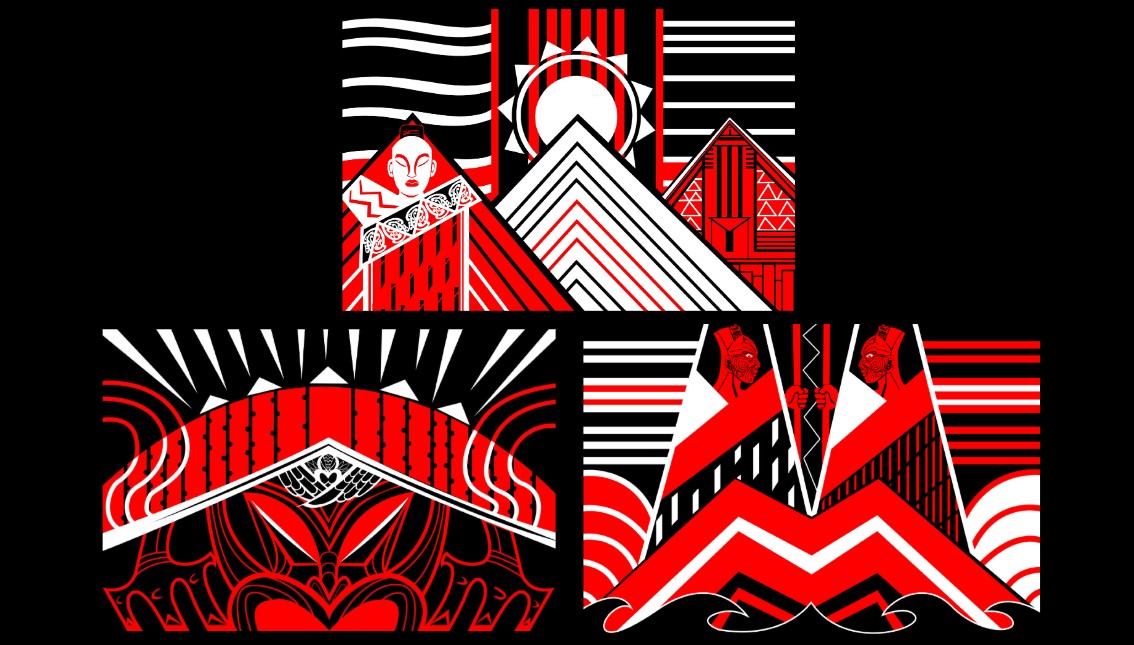
When the tipuna of Te Āti Awa arrived in Te Whanganui-a-Tara in the 1800s, the sacred hills and mountains around the harbour already had special names. In te reo Māori, these tall hills are often called “puke”.
Three key peaks stand as guardians over the land, each carrying a deep spiritual meaning:
- Pukeariki (Belmont Hill): In the artwork above, swirling wind and human figures are shown above this hill, representing the howling breezes that blow across the peak and its connection to the people.
- Pukeatua (Wainui Hill): Standing proudly in the east, this peak catches the very first rays of the morning sun. Sacred lines stretch upward from Pukeatua to reach Ranginui (the Sky Father).
- Pukeahu (Mt Cook): Because this location is so peaceful and sacred, the artwork above depicts the winds resting calmly above it. Today, Pukeahu is home to the National War Memorial Cenotaph.
The red, curving mountain known as Te Ahumairangi holds rich stories woven right into the landscape:
- Rangi’s Tears: In the artwork, wavy lines flowing down the mountain represent Ranginui’s roimata, which fell from the sky to create the freshwater streams and rivers.
- Living Forest: Curving vine patterns show the lush native plant life that once covered the hillside.
- Five Villages: Five distinct triangles represent the five pā built on the mountain, where each village served a specific purpose for the community.
- Skyward Lines: Vertical lines stretch into the clouds, representing the strong spiritual link between the land and the sky above.
According to legend, two great taniwha once lived inside Wellington Harbour. One of them, named Whātaitai, tried to leap out to the open ocean but got stranded when the waters receded!
Whātaitai’s body became the mountain Mātai-rangi (Mt Victoria). As his spirit left his body, it let out a final, haunting cry—a moment remembered in the name Tangi te Keo. Whātaitai’s spirit transformed into Manu muramura, a brilliant bird that burst into flames, soaring upward into the sky to connect with nature, the elements, and all living things.
Looking across the region, the grand pae maunga of the Tararua Ranges forms a natural border separating Te Whanganui-a-Tara from the Wairarapa:
- The Great Fish: This landscape ties directly into the legend of Te Upoko o te Ika, where the harbour forms the eyes of the giant fish.
- Rangatira Guardians: High rangatira from two iwi—Rangitāne and Ngāti Kahungunu—stand on each side of the range. Together, they hold the mana of this land.
- Sun and Sea: Artwork captures the daily rhythm of life here: the sun rising over the eastern hills, setting in the west, and resting upon the ocean waters below.
Reo Māori
| Māori | English | Māori | English |
| tipuna | ancestor | Te Whanganui-ā-Tara | Wellington |
| puke | hill | ariki | chief, leader |
| atua | god | ahu | sacredness |
| roimata | tears | pā | fortified village |
| taniwha | sea guardian | Tangi te Keo | Screech of Keo |
| pae maunga | mountain range | Te Upoko o te Ika | The Head of the Fish |
| rangatira | chief | mana | authority and spiritual strength |