
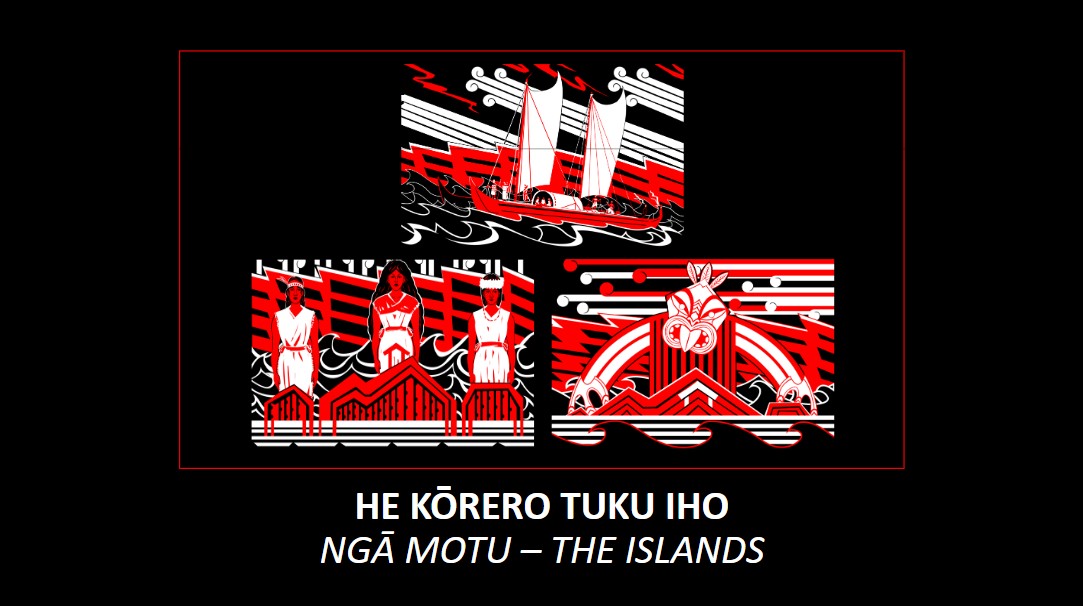
Long ago, extraordinary navigators sailed across the vast Pacific Ocean, guided by the stars, the ocean currents, and the wind. They traveled in a magnificent double-hulled waka with large sails, spending 6 to 8 weeks on the open ocean where no land could be seen in any direction—unlike smaller paddling waka, which always stayed close to the shore.
One of the most famous voyagers was Kupe, who arrived on the waka named Matahourua. Traveling alongside him was his wife, Kuramarotini (also known as Hineaparangi).
When Kupe’s family explored the swirling waters of Te Whanganui-a-Tara (Wellington Harbour), they named the three islands inside the harbour after Kupe and Kuramarotini’s daughters:
- Mātiu (Somes Island)
- Mākaro (Ward Island)
- Mokopuna (Leper Island)
If you stand on the beach at Seatoun today, you can look out across the waves and see these three motu clearly. Looking at the harbour landscape, the front of the harbour forms the shape of the jaws of a great fish, backed by the sweeping pae maunga.
The stories of Kupe are not just ancient pūrākau; they are kōrero tuku iho: real history passed down through generations. Real people lived on these islands and left behind names that preserve their stories.
People once lived on Mātiu, building traditional whare. When Kupe’s people first arrived, their clothing looked much like the traditional attire worn in Tahiti and nearby Pacific islands, reflecting the homeland they had sailed from.
Kupe left his mark all around the region:
- Mana Island was named Te Mana o Kupe to honor his great authority and skill.
- Steeple Rock, a sharp rock rising out of the water near Seatoun, was named Te Aroaro-o-Kupe (and originally Te Ure o Kupe), marking his presence in the harbour.
In local artwork and pikitia, you often see koru shapes. These shapes represent the strong, swirling winds that blow across Wellington. Today, these three islands are under the mana of Taranaki. The emblem of three white feathers represents the people of Taranaki, who act as kaitiaki caring for the harbour’s three motu.
Reo Māori
| Māori | English | Māori | English |
| waka | canoe | Matahourua | double-hulled canoe |
| motu | island | pae maunga | mountain range |
| pūrākau | creation story | kōrero tuku iho | story based in history |
| whare | house | pikitia | picture, artwork |
| koru | spiral shape | mana | authority and spiritual protection |
| kaitiaki | guardian |